
• HOME
  • About us
    • About Us
    • Team & Experience
    • Solutions
    • Contact
  • RDT insights
  • Investment Porfolio
  • Menu
    • Electrical Demand
    • Water Solutions
    • Carbon Footprint Analyses
    • Waste to Energy
    • Solar Energy
    • Eco-Agro/Program
    • Hydroelectric Energy
    • Wind Energy
    • Forest Carbon
    • sustainable Automations
  • Más
    • HOME
    • About us
      • About Us
      • Team & Experience
      • Solutions
      • Contact
    • RDT insights
    • Investment Porfolio
    • Menu
      • Electrical Demand
      • Water Solutions
      • Carbon Footprint Analyses
      • Waste to Energy
      • Solar Energy
      • Eco-Agro/Program
      • Hydroelectric Energy
      • Wind Energy
      • Forest Carbon
      • sustainable Automations
  • Iniciar sesión
  • Crear cuenta

  • Mi cuenta
  • Iniciaste sesión como:

  • filler@godaddy.com


  • Mi cuenta
  • Cerrar sesión

Iniciaste sesión como:

filler@godaddy.com

  • HOME
  • About us
    • About Us
    • Team & Experience
    • Solutions
    • Contact
  • RDT insights
  • Investment Porfolio
  • Menu
    • Electrical Demand
    • Water Solutions
    • Carbon Footprint Analyses
    • Waste to Energy
    • Solar Energy
    • Eco-Agro/Program
    • Hydroelectric Energy
    • Wind Energy
    • Forest Carbon
    • sustainable Automations

Cuenta

  • Mi cuenta
  • Cerrar sesión

  • Iniciar sesión
  • Mi cuenta

Country Market Electrical Demand

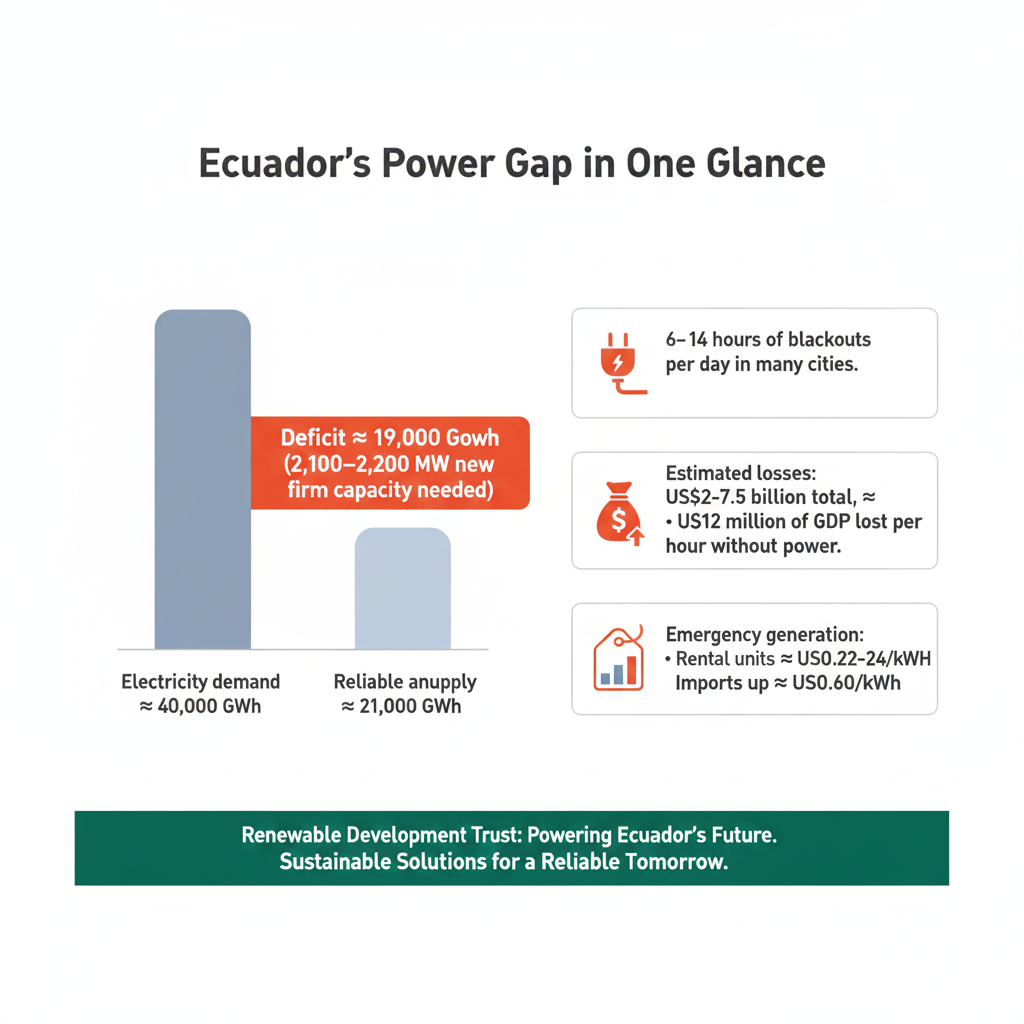
Ecuador has moved from occasional power exporter to structural deficit. Electricity demand has been growing at roughly 7 percent per year, with system demand projected around 40,000 GWh by 2025. Yet very little firm capacity has been added since 2016, leaving an estimated 19,000 GWh gap and a need for about 2,100–2,200 MW of new generation just to get back on track.


This under-investment translated into a full-blown crisis in 2023–2024. Severe drought at major hydro plants and neglected thermal assets meant that out of roughly 2 GW of installed fossil capacity, only about 880 MW was truly operational. Rolling blackouts started at up to 8 hours per day and by late 2024 reached 12–14 hours in many cities, with cumulative economic losses estimated between US$2 and US$7.5 billion and some analyses pointing to roughly US$12 million of GDP lost for every hour without power.


To keep the lights on, the government has had to rent fuel-oil generators at roughly US$0.22–0.24 per kWh and pay up to US$0.60 per kWh for emergency imports from Colombia, even as it works to stabilize the system. In October 2024, regulators introduced a dedicated tariff for new private renewable and biomass projects of about US$0.11864 per kWh, with rates grandfathered once permitting is submitted, creating a clear price signal for long-term private generation.


Against this backdrop, coastal and urban demand nodes on your map are not just colors – they are the front lines of the deficit. They are where outages have been most damaging for industry, agriculture, and services, and where new firm and complementary generation is most needed. RDT’s waste-to-energy, coastal wind–solar, water and storage pipelines are being designed and sized in direct response to this gap, turning a 19,000 GWh national shortfall and 6–14-hour blackouts into a defined opportunity set for long-term, contracted cash-flow assets.

Clear deficit. Clear price signal.

RDT’s WTE, renewables, water and Eco/Agro portfolios are built to fill this gap.  

Explore How our Investment Portfolio solutions are positioned to turn this deficit into long term, contracted cash flows. 

Learn more

Leadership & expirience

Meet our team

Ready to start your Investment?

Let’s explore how Renewable Development Trust can align your capital with sustainable, cash-flowing infrastructure. 

Let's talk


The information on this website has been prepared by Renewable Development Trust S.A. (“RDT”) for general informational purposes only. It does not constitute an offer to sell or a solicitation of an offer to buy any security or investment product. Any investment with RDT will be made only through formal offering documents, which contain important information about terms, risks, fees and other conditions.

Investments in private, illiquid and infrastructure related assets are speculative and involve a high degree of risk, including the possible loss of the entire amount invested. Target returns, IRRs and other forward looking statements are based on assumptions that may change and are not guarantees of future performance; past results do not predict future outcomes. RDT makes no representation as to the accuracy or completeness of the information on this site and assumes no obligation to update it. Visitors should consult their own legal, tax and financial advisers before making any investment decision.

Copyright © 2025 Renewable Development Trust SA - All rights reserved.


  • HOME
  • Carbon Footprint Analyses
  • Eco-Agro/Program
  • Forest Carbon
  • sustainable Automations

Este sitio web utiliza cookies

Usamos cookies para analizar el tráfico del sitio web y optimizar tu experiencia en el sitio. Al aceptar nuestro uso de cookies, tus datos se agruparán con los datos de todos los demás usuarios.

RechazarAceptar